
Advertising notes
Reading Computational Advertising
An overview of online advertising
The three core assets of a product that can be monetized:
- Traffic
- Data (user gender, behavior, intentions, and so on)
- Influence
Advertising concepts
- Sponsor
- Media
- Audience
The essential function of advertising is to use a medium with a broad audience to reach users at a relatively low cost.
Return on investment (ROI)
Brand advertising and performance advertising
Brand advertising: create a distinctive, positive brand or product image, with the goal of improving offline conversion over a relatively long period.
Performance advertising: advertising with a clear short-term goal of user conversion. Conversion actions include purchasing, registering, voting, and donating. Most internet advertising falls into this category.
Targeted advertising systems
- Audience targeting
- Ad serving
Guaranteed delivery (GD) is more closely related to brand promotion and CPM.
The most common eCPM (expected cost per mille) is expected revenue per thousand impressions.
Auction advertising
Ad network (ADN)
CPC (cost per click)
Revenue per mille (RPM)
Real-time bidding
(real-time bidding, RTB)
Advertising effectiveness models
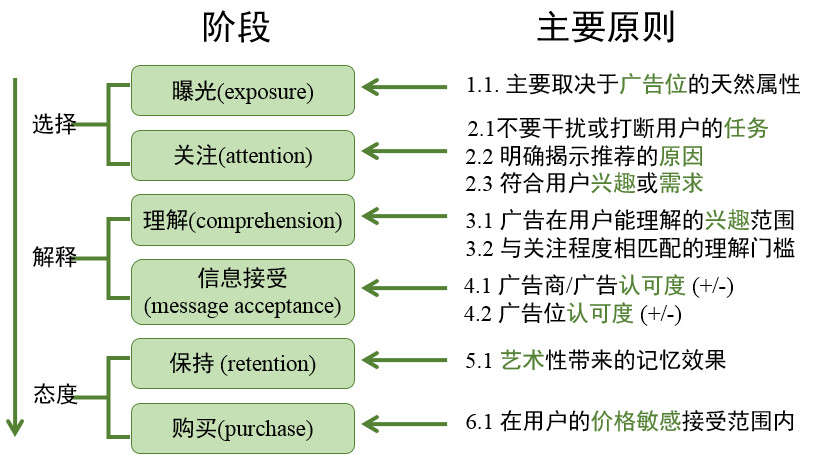
2. Fundamentals of computational advertising
Expected cost per mille (eCPM)
$$ ecpm = r(a,u,c) = u(a,u,c) * v(a,u) = u(a,u,c)*c(a,u)*t(a) $$
The three participants in an advertising campaign are:
a, u, and c: the ad, user, and context.
Click rate × click value can be broken down further into click-through rate, conversion rate, and conversion value.
Advertising pricing models
CPT
Cost per time: used by portal websites and priced by time.
CPM
Cost per mille: charge for every thousand impressions.
CPC
Cost per click.
CPS / CPA / ROI
Cost per sale, cost per action.
oCPX
Comparison of online advertising pricing models:
| Pricing model | Click-rate estimate | Click-value estimate | Advantages and disadvantages | Use case |
|---|---|---|---|---|
| CPT | Demand side | Demand side | Can make use of the storefront effect | Brand advertising with high exposure |
| Cannot use audience-targeting technology | ||||
| CPM | Demand side | Demand side | Can use audience targeting to choose the target audience | Brand advertising that needs audience selection |
| Under contract sales, audience segments cannot be too granular | Real-time bidding ad exchange | |||
| CPC | Supply side | Demand side | Can finely segment different audiences | Auction ad network |
| A relatively reasonable division of labor | ||||
| CPS / CPA / ROI | Supply side | Supply side | No direction from the demand side | Performance ad network |
| More difficult for the supply side to operate | Performance DSP | |||
| oCPX | Supply side | Supply side | Transition toward the CPA model | Advertising platforms with strong data capabilities |
Online advertising product logic
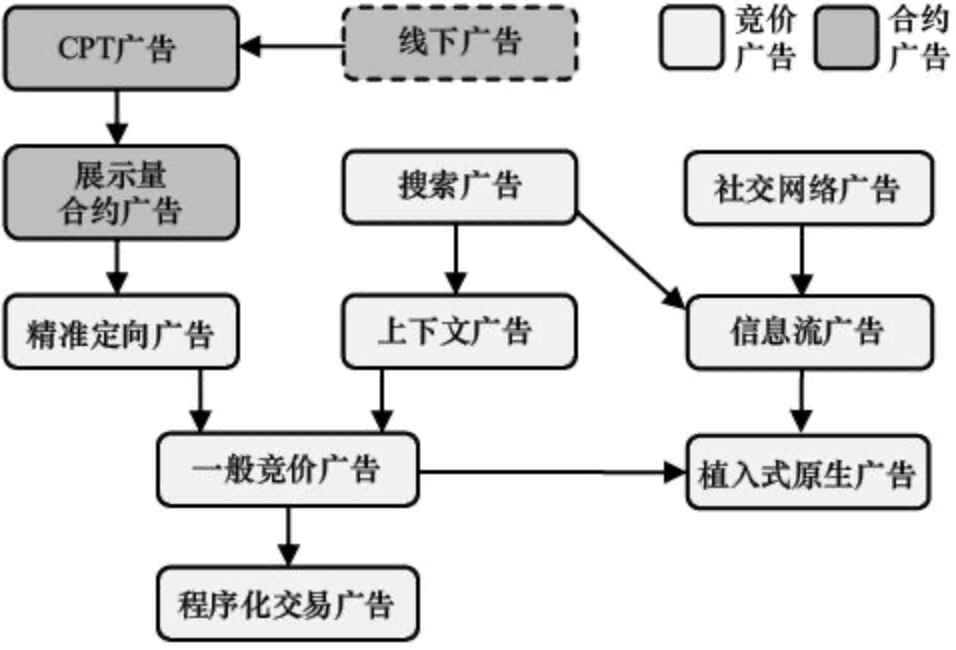
$$History of online advertising development$$
2.3.1 Advertising revenue breakdown
CTR (click-through rate)
CVR (conversion rate)
Auction advertising
Auction advertising strategies
Nash equilibrium: a stable market balance.
State announcement:
Auction mechanisms:
- Generalized second price (GSP)
- The advertiser receives the position at the first price and pays the second price. The mechanism is relatively simple and stable.
- VCG
- Optimizes social welfare.
MRP: market reserve price (the floor price).
Division of computation and product direction in auction advertising:
| Pricing model | Click-through rate | Conversion rate | Conversion value | Product focus |
|---|---|---|---|---|
| CPC auction | Supply side | Demand side | Demand side | |
| Programmatic trading | Demand side | Demand side | Demand side | Real-time quotation |
| Smart delivery | Supply side | Supply side | Demand side | oCPX |
Programmatic advertising
DSP: demand-side platform.
SSP: supply-side platform.